|
|
Citizen
Join Date: 16 Oct 2011
Location: piedmont, italy
Posts: 159
|
back to the original topic: do you think it would make sense to date the TdM pictorial style at the beginnig of the 16th century, due to the similarity with some contemporary woodcuts? and is it right to presume that cardmakers have continued to draw new woodcuts with an original 16th century TdM in mind? |
|
|
|
|
|
Ask a Professional Tarot Reader Top #11 |
|
Ads by Google
via Google Adsense
|
|
| #ADS |
|
Citizen
Join Date: 02 Jul 2003
Location: Germany
Posts: 2,339
|
Quote:
It might be more of worth to study first all available information about the Marseille Tarot itself, as it is accepted as a deck of 17th and 18th century. That already might be a lot of work. __________________ Huck "getting it home to the writing desk" Last edited by Huck; 08-11-2011 at 06:40. |
|
|
|
|
|
|
|
Ask a Professional Tarot Reader Top #12 |
|
Citizen
Join Date: 16 Oct 2011
Location: piedmont, italy
Posts: 159
|
I'm not sure I got your point. Let's leave aside for a moment any historical problem: I was just arguing that the aestethics (faces, clothes, ways of depicting characters etc...) didn't look 18th century at all, that is quite obvious even to an art amateur. What is even stranger is that this model was still in use well into the 19th century. take for instance the Guala tarot (which is from 1840! -- LoS edition actually says 1860 but it seems to be a mistake). so what I'm assuming here is that in that case the wood carver had in mind a precise design for each card, and that design wasn't contemporary at all). so there should be an older original model for the TdM which maybe got lost... or shall we presume that because we miss historical datas that the FIRST ever tdM-style deck was the Noblet (1650!). |
|
|
|
|
|
Ask a Professional Tarot Reader Top #13 |
|
Citizen
Join Date: 16 Oct 2011
Location: piedmont, italy
Posts: 159
|
I was reading (Depaulis - antichi tarocchi liguri-piemontesi) that in Piedmont back in 1810 the French tried to change the tarocco pattern (David was commissioned a design) but that was unsuccessful. I guess that there was a strong tradition among players and a sudden change simply wasn't accepted. If it's true that at least from early 16th century Tarot was already played in France, we can argue that by 1700 this tradition was well established. players would learn to play from generation to generation and they were used to that pattern. so if a card maker wanted to sell his cards had to follow a traditional pattern, as novelty decks weren't the norm... plus consider italian regional decks, the bresciane for instance. still today they've got that 16th century style because people who usually play cards simply want that style! hope this makes sense
|
|
|
|
|
|
Ask a Professional Tarot Reader Top #14 |
|
Citizen
Join Date: 02 Jul 2003
Location: Germany
Posts: 2,339
|
Quote:
... .-) ... In research we usually learn from the experiences of others. Ross stated in this thread: Quote:
Quote:
I wrote once: http://tarotforum.net/showthread.php...55#post2600207 Quote:
Nonetheless the statement had been made: Tarot was imported from Germany. How does this explain? Well ... the question is: Who were "the Germans" in c. 1650 ... from French perspective? First, very simple, they would see an Emperor with Empress in the deck. Would a French citizen recognize this as a French deck? NO. It MUST be foreign. As there is an Emperor in the deck, it SHOULD come from Germany. Politically parts of Italy were German or Roman Empire (somehow Austria in this time). So, if the deck was known to come from specific places in Italy - let's say Mantova - it easily might have been considered German in 1650. Now France got somebody from Mantova in 1565: the duke of Nevers (not too far from Paris) was a Gonzaga-son. And just somebody born in this French Gonzaga-house in 1637 gave the order to write the Tarot rules down. Well, from French perspective this Gonzaga descend might have been "German", though already living in France for c. 80 years in 1650. Also Nevers was connected to Rethel (they reigned at both places, and the family first had Rethel and later Nevers). This original family, to which the Gonzaga-son married, was original from Cleve, a Western part of Northern Germany. The usual French citizen had reason to address this family as Germans. Also we have the factor, that France was growing in 17th century http://www.zum.de/whkmla/histatlas/f...haxfrance.html How would the new population in these regions been seen from "original French perspective"? Likely they would have been seen as "Germans inside France" for a longer time. These are regions, which still have the most Tarot playing communities. http://www.fftarot.fr/index.php/Clubs.html ... shows a map. The regions with the most intensive green have the most clubs. That's mainly the region around Lyon with some nearness to Nevers, where the Gonzaga's reigned. And not too far to Baden-Würtemberg, where Cego still is played. Vievil came "likely" from the region, which is now Western Belgium. It might well be, that this 17th century also was addressed with Germany. The only modern German region, which still plays a Tarot-variant called Cego, is Baden-Würtemberg at the French border. __________________ Huck "getting it home to the writing desk" Last edited by Huck; 09-11-2011 at 05:20. |
||||
|
|
|
||||
|
|
Ask a Professional Tarot Reader Top #15 |
|
Citizen
Join Date: 16 Oct 2011
Location: piedmont, italy
Posts: 159
|
16th centurty TdM?
maybe my post wasn't too clear. What I was trying to say is that there *could* have been an ur-tarot de Marseille already in the 16th century, since we can argue from historical sources that the French imported the tarot from italy around 1500, is that right? so we must assume that from 1500 to 1650 (earliest document) people in France had been playing tarot. my point was: what kind of deck was it? then observing the TdM from a purely aesthetical point of view I claimed that the 1650 noblet could have been based on an earlier model because of a certain tradition. take for instance the Bresciane regional deck, still used today: it has a really old design, (probably 15 century) but they're nowhere likely to change it ihttp://it.wikipedia.org/wiki/File:Carte_bresciane_al_completo.png when Napoleon wanted to change the piedmontese tarot because it probably was too ancien regime, he failed. the new design wasn't accepted by players... I guess in card games tradition plays an important role. Players don't want to change their usual card stock--they are used to certain designs because that way it was easier to remember cards so by 1650 why should noblet decide to produce a brand new deck with new designs, when probably many people were already playing tarots in France? the fact that we don't have an older card deck is nothing strange. cards were really fragile, plus they generally weren't luxury items... it is a fortune that we still have 2 copies of the Noblet (who knows meanwhile how many cards were produced? maybe hundred thousands!!! and only 2 left???) this is of course just an hypothesis, I'm not trying to demonstrate anything but maybe there could be something worth thinking... |
|
|
|
|
|
Ask a Professional Tarot Reader Top #16 |
|
Citizen
Join Date: 29 Dec 2003
Location: Nr. Ephesus, Turkey
Posts: 4,621
|
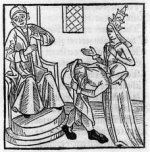
A fifteenth century Pope Joan attached. French, from the 'in defense of woman' genre: Full bibliographical details and links in post here: http://www.tarotforum.net/showpost.p...7&postcount=76 __________________ "I am a diviner, but a poor one." |
|
|
|
|
|
Ask a Professional Tarot Reader Top #17 |
|
Citizen
Join Date: 02 Jul 2003
Location: Germany
Posts: 2,339
|
Quote:
Why not going to the oldest, that you know of the Marseille decks instead of starting to search there, where you want go to? That would be somehow Jacques Vievil in Paris, and Paris isn't Marseille ... and it is c. 1650 and some people living in Paris have the opinion, that Tarot came from Germany. ... I would invite you to read here a little bit: it starts with the Tarot Rules of 1637 and there is a Fame Problem with the Vievil cards ... but perhaps first this, the opinion of an expert: http://tarotforum.net/showthread.php...vievil&page=28 Quote:
http://en.camoin.com/tarot/Francois-...les-Tarot.html ************ So in these French discussions neither the Noblet or the Vievil deck seem to be accepted as "Tarot de Marseille". And from their discussion it's clear, that they fight for quite less distances in time than a jump of 150 years as your suggestion, or 500 years and more as in other Tarot-de-Marseille suggestions. ************ More in the above given links. __________________ Huck "getting it home to the writing desk" |
||
|
|
|
||
|
|
Ask a Professional Tarot Reader Top #18 |
|
Citizen
Join Date: 16 Oct 2011
Location: piedmont, italy
Posts: 159
|
Of course I was considering TdM in a broader sense (e.g. some of early piedmontese decks like the Ottone are defined TdM I, even though they are clearly not from Marseilles) What I'm trying to say is that what has reached us (noblet, dodal, tarot de paris etc...) is clearly NOT (at least to me ) an 18th century design. At this point we could only presume that an older original tarot already existed starting from 16th century in France. This is purely from an artistic point of view. Are there any reasons to refute such a thesis? |
|
|
|
|
|
Ask a Professional Tarot Reader Top #19 |
|
Citizen
Join Date: 07 Jul 2003
Location: Béziers, France
Posts: 2,364
|
Quote:
Then we have the Cary Sheet, whose provenance and date is unknown. But I doubt anyone would put it later than 1500. There are some distinct differences with the TdM of course, but it is clearly related to the much later TdM style. Unfortunately we don't have the World card, which would be interesting to see because no Italian deck has the nude in the victory wreath like the TdM does (excepting for the Sforza Castle card, which is surely Italian (it uses the fold-over backing, which French cards never did, as far as I know). But it is hard to date as well - it may be late enough to be an Italian production of a French type, although I think the consensus is about 1600). I think the earliest evidence, albeit indirect, comes from Mallorca, of all places. In 1588 the Inquisitor of Mallorca denounced the introduction of cards “printed in France”, in which were represented a Pope with a tiara, a Popess, the Angel of the Last Judgment, Death, Cupid, the four Evangelists, the Moon, the stars, etc. I think the "four Evangelists" is best interpreted as a reference to the TdM style of the World card. (There are more references to Tarot in Spain in Jean-Pierre Etienvre, in Figures du jeu: études Lexico-Semantiques Sur Le Jeu De Cartes En Espagne (XVIe-XVIII siècle) (Casa de Velazquez, 1987) pp. 293-294; see my post here http://ludustriumphorum.blogspot.com...pain-16th.html ) __________________ ΑΓΕΩΜΕΤΡΗΤΟΣ ΜΗΔΕΙΣ ΕΙΣΙΤΩ Trionfi http://trionfi.com Tarot Essays http://www.angelfire.com/space/tarot Last edited by Ross G Caldwell; 12-11-2011 at 00:46. |
|
|
|
|
|
|
|
Ask a Professional Tarot Reader Top #20 |
![]() |
| Bookmarks |
| Thread Tools | |
|
|