
Aeclectic Tarot
Tarot Decks Talk Tarot Learn Tarot Tarot Readings Tarot Books

  Aeclectic Tarot Forum > Tarot > Tarot Spreads

Notices


Reply
 
Thread Tools
Sophie 
Citizen
 
Sophie's Avatar
 
Join Date: 10 Oct 2004
Location: moving again
Posts: 20,308
Tirage en Croix


Following requests from prudence and Debra, here is the classic Tirage en Croix, which is usually done with Marseille Majors only. Though it works particularly well with all-Majors, it can, of course, be adapted to the full deck, and to any other deck. I find it invaluable for exploring a question in a succinct but quite deep way. It is based on the French dialectic of Thesis-Antithesis-Synthesis-Conclusion, with a fifth element, the Quintessence, which is the spiritual or overarching message of the reading.

The basic format is this:


*******3*******

1******5******2

*******4*******


1. the thesis, is the statement of the question and what favours it. So for instance, if you want to know how the sale of your house is going to go, you would ask under this position: "what is favouring the sale of my house?".

2. is the antithesis - what opposes you. So in our example: "what does not favour the sale of my house".

3. is the synthesis - where things are now, how you can take advantage of the knowledge in both cases, what is demanded of you, etc. Here, we might ask something like: "where do things actually stand between these two?" or "how might I act to lean things in my favour?".

4. is the conclusion - the outcome. Where the sale of your house is going for the moment. Using that simple dialectic of thesis-antithesis-synthesis will explain to you why you got the Hanged Man rather than the World, for instance!

5. the Quintessence. It is the overarching message - and a possible way of unblocking the situation if the outcome is not as you please, or a re-affirmation of one of the 4 positions (it's not uncommon for the Quintessence to be the same card as one of the 4 others, which should give you an idea of the weight of that card in your question). It can also be the spiritual element, or something that you bring unconsciously to the question. It is made up of the sum of the four other cards, reduced to a number between 1 and 22 (with the Fool being, for that purpose, 22).


You can vary the questions attached to the positions ad infinitum, using the simple thesis-antithesis-synthesis-conclusion-quintessence format.

It works with Majors so well, because this dialectic is designed to look at the greater issues, not the details. If you read a French essay, you will recognise that dialectic, and the concentration on conceptual or major issues, rather than small details.

Once you have those "big issues" sorted out, you can then do another reading with minors, if you need it. I often don't. Some readers, after the main reading is done, lay one or several minors onto each of the Majors, which show the details related to that issue. It might confirm or modify the Major in question.


__________________
All generalizations are false, including this one.
Mark Twain

Last edited by Sophie; 10-05-2007 at 01:58.
Sophie is offline   Reply With Quote
Old 09-05-2007 Ask a Professional Tarot Reader     Top   #1

Ads by Google
via Google Adsense


  #ADS
Debra 
sporadic magic
 
Debra's Avatar
 
Join Date: 21 Sep 2006
Location: Normally, one place at a time.
Posts: 13,061

Thank you! I see this is to the point and like it right off the bat.
Debra is offline   Reply With Quote
Old 09-05-2007 Ask a Professional Tarot Reader     Top   #2
RussianSoul 
Citizen
 
RussianSoul's Avatar
 
Join Date: 29 Sep 2006
Location: Chicago USA
Posts: 1,076

This is a great spread, I am copying it into my favorite spreads collection. I am also thinking it would be great for the next TdM Round. Thank you for sharing, Fudugazi!
RussianSoul is offline   Reply With Quote
Old 10-05-2007 Ask a Professional Tarot Reader     Top   #3
prudence 
reader
Moderator
 
prudence's Avatar
 
Join Date: 31 Jan 2005
Location: between two ferns
Posts: 5,596

Printing this out right now....Thank you, Fudugazi!!!!!


__________________
When the moon is a counterfeit, better find the one that fits.
Better find the one that lights the way for you ~Beck
prudence is offline   Reply With Quote
Old 10-05-2007 Ask a Professional Tarot Reader     Top   #4
Sheri 
Citizen
 
Join Date: 22 Jan 2006
Posts: 5,270

Fantastic spread, Fudugazi!

Thanks for sharing it

I have several Majors only decks (they seem to come to me for some reason) and it is difficult finding spreads that are for Majors only (I've got Umbrae's Window/Door spread too). So I typically end up just pulling one or 2 cards - or adapting an oracle spread.

This is great!

valeria
Sheri is offline   Reply With Quote
Old 10-05-2007 Ask a Professional Tarot Reader     Top   #5
kwaw 
Citizen
 
kwaw's Avatar
 
Join Date: 29 Dec 2003
Location: Nr. Ephesus, Turkey
Posts: 4,621

Quote:
Originally Posted by Fudugazi
It is made up of the sum of the four other cards, reduced to a number between 1 and 22 (with the Fool being, for that purpose, 22).
Or alternative method keep deducting 22 from the final result until you get a number between 0-21?


__________________
"I am a diviner, but a poor one."

Last edited by kwaw; 12-07-2007 at 07:50.
kwaw is offline   Reply With Quote
Old 12-07-2007 Ask a Professional Tarot Reader     Top   #6
kwaw 
Citizen
 
kwaw's Avatar
 
Join Date: 29 Dec 2003
Location: Nr. Ephesus, Turkey
Posts: 4,621
Implications of using theosophical reduction:


Using theosophic reduction means that if any of the first four cards to be summed are numbered 17 or above, then none of the cards in the range 17-'22' can be a quintessential card; that is these cards can only be quintessential by addition of the four turned, and never by reduction and never in combination with another high numbered card (the highest sum if fool counted as 22 not 0 is 22+21+20+19=82, the highest number then by reduction = 79 = 7+9 = 16; if fool counted as 0 then highest sum is 21+20+19+18=78, highest number by theosophic reduction then 7+8=15).

Cards 1 or 2 can never be a quintessential card (as can not be achieved by addition of four cards and theosophic reduction of any sum will stop at 10 or 11).

3-5 can only occur by reduction (the lowest number by addition being 0+1+2+3=6), 3 only if the sum is 30 and 4 if 31 or 40, 5 if sum is 23, 32, 41 or 50.

Does this tell us anything about the meaning of these cards and their relationship to the others? Are the rare quintessential cards more significant than common ones? Is there any justification for never considering the basteleur or papesse as quintessential cards? Is there any qualitive difference between those quintessential cards that can be arrived at only by the sum of the four cards turned and those only by theosophic reduction of the sum of the four turned cards? Or between those that can be duplicated as quintessential cards and as one of the four turned up and those for which this is not possible? Or have I got the method or my sums wrong?

00 no combinations but 22 taken as Fool
01 no combinations
02 no combinations

By theosophic reduction of the sum of four turned cards only:
03 if sum is 30
04 if sum is 31 or 40
05 if sum is 23, 32, 41 or 50

By sum of four cards or the theosophic reduction of their sum:
06 if sum is 06, 24, 33, 42, 51 or 60
07 if sum is 07, 25, 34, 43, 52, 61 or 70
08 if sum is 08, 26, 35, 44, 53, 62, 71 or 80
09 if sum is 09, 27, 36, 45, 54, 63, 72 or 81
10 if sum is 10, 28, 37, 48, 55, 64, 73 or 82
11 if sum is 11, 29, 38, 47, 56, 65 or 74
12 if sum is 12, 39, 48, 57, 66 or 75
13 if sum is 13, 49, 58, 67 or 76
14 if sum is 14, 59, 68 or 77
15 if sum is 15 or 69 or 78
16 if sum is 16 or 79

By sum of four turned cards only:
17 if sum is 17
18 if sum is 18
19 if sum is 19
20 if sum is 20
21 if sum is 21
22 if sum is 22


__________________
"I am a diviner, but a poor one."

Last edited by kwaw; 12-07-2007 at 18:37.
kwaw is offline   Reply With Quote
Old 12-07-2007 Ask a Professional Tarot Reader     Top   #7
kwaw 
Citizen
 
kwaw's Avatar
 
Join Date: 29 Dec 2003
Location: Nr. Ephesus, Turkey
Posts: 4,621

Quote:
Originally Posted by kwaw
Using theosophic reduction means that if any of the first four cards to be summed are numbered 17 or above, then none of the cards in the range 17-'22' can be a quintessential card; that is these cards can only be quintessential by addition of the four turned, and never by reduction and never in combination with another high numbered card (the highest sum if fool counted as 22 not 0 is 22+21+20+19=82, the highest number then by reduction = 79 = 7+9 = 16; if fool counted as 0 then highest sum is 21+20+19+18=78, highest number by theosophic reduction then 7+8=15).

Cards 1 or 2 can never be a quintessential card (as can not be achieved by addition of four cards and theosophic reduction of any sum will stop at 10 or 11).

3-5 can only occur by reduction (the lowest number by addition being 0+1+2+3=6), 3 only if the sum is 30 and 4 if 31 or 40, 5 if sum is 23, 32, 41 or 50.

Does this tell us anything about the meaning of these cards and their relationship to the others? Are the rare quintessential cards more significant than common ones? Is there any justification for never considering the basteleur or papesse as quintessential cards? Is there any qualitive difference between those quintessential cards that can be arrived at only by the sum of the four cards turned and those only by theosophic reduction of the sum of the four turned cards? Or between those that can be duplicated as quintessential cards and as one of the four turned up and those for which this is not possible?
Wirth notes on p.185 of 1985 Samuel Weiser paperback edition of the Tarot of the Magicians that though the method was first recorded for us by Stanislas de Guaita, the method was pointed out to S.d.Guaita by Joseph Peladan, so it does not apparently originate with de Guaita.

On the fifth arcana of the spread Wirth says:

"A fifth arcana completes the throwing of light upon the oracle which it synthesises, for it depends upon the four arcanas drawn. Each of these bears the number which marks its rank in the series of the Tarot (the fool, who is not numbered, counts for 22). When these numbers are picked out, it is enough to add them together to obtain, either directly or by theosophic reduction, the number of the fifth arcana (22 indicates the Fool, 4 the Emperor, 12 the Hanged Man etc)."

On p.186 "The numbers of the drawn cards are added up. If the total equals, or is below 22 the synthesis is the Fool or the arcana to which the sum total corresponds in the numerical order of the Tarot. If the total is more than 22 then its two numbers added together indicate the synthesising arcana (32=2+3=5)(57=5+7=12 etc).

On p.187 he writes:"This synthesis in fact relates to what is of prime importance and on which everything depends." Nowhere however is mention made, and totally excludes the possibility of Bateleur or Papesse. In neither 'Tarot of the Magicians' nor 'Introduction to Study of the Tarot' is any mention made of the artefacts of this method; of the fact for example that by this process neither Bateleur nor Popesse can ever be the card of 'synthesis' or that the method described gives a greater probability of some cards over others being the fifth card.

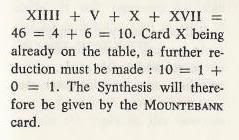
In Alain Bocher’s LWB of the Tarot de la rea 1982 however a modification of the method is described in which it is possible to arrive at cards I or II as fifth card:
(My thanks to MinchiMan for this reference).

The new rule has other implications, it means for example that only the single figured cards 1-9 can in this method be both in the spread and duplicated as a quintessential/synthesis card, does this qualify in any way how these cards are interpreted? Although by addition of this new rule there is the possibility of the Bateleur and Popesse being a quintessential card, the probability remains rare; and can only occur in case of Bateleur in combination with X-WoF in spread and for Popesse if XI or XX is in spread. Again, how (if at all) does this qualify how these cards are interpreted?

For example:

I+X+IX+VI=28=10, as 10 already in spread according to above rule we must reduce again 1+0=1.

So 'I' is both in spread and quintessential.

It appears of course as 'synthesis' card with X in spread, as that is the only possible way in which it can.

So does the combination of 'X' in spread and 'I' as quintessential effect how they are read, as they can only appear in this combination? X is ‘common’ relative to 'I' as quintessential being rare, so we have a relationship perhaps of common/rare or many/one. We could for example see the WoF as 'gamblers' and Juggler as the 'operator of a gambling game (or the 'house')', so we have the idea of one gambling operator or house catering to many gamblers. By extension we might read then 'X' as 'opportunities', and 'I' as 'entrepreneurial opportunist' who takes advantage of them.

Any ideas for the combinations of Popesse as 5-quintessential/synthesis with XI and/or XX?

Kwaw

Last edited by kwaw; 20-07-2007 at 09:09.
kwaw is offline   Reply With Quote
Old 20-07-2007 Ask a Professional Tarot Reader     Top   #8
kwaw 
Citizen
 
kwaw's Avatar
 
Join Date: 29 Dec 2003
Location: Nr. Ephesus, Turkey
Posts: 4,621

Quote:
Originally Posted by kwaw
Or alternative method keep deducting 22 from the final result until you get a number between 0-21.
The highest sum in a four card (majors only) spread is 21+20+19+18=78.

22 is subtracted from any sum at or above 22 until it fall in range 0-21:

00 22 44 66

01 23 45 67
02 24 46 68
03 25 47 69
04 26 48 70
05 27 49 71
06 28 50 72
07 29 51 73
08 30 52 74
09 31 53 75

10 32 54 76
11 33 55 77
12 34 56 78

13 35 57
14 36 58
15 37 59
16 38 60
17 39 61
18 40 62
19 41 63
20 42 64
21 43 65

Compared with theosophic method (any number reduced to figure 22 or below by addition of each digit of sum, e.g. 23=2+3=5):

Not possible (without additional rules):

00 no combinations
01 no combinations
02 no combinations

By theosophic reduction of the sum of four turned cards only (that is these cards cannot be quintessential from sum of four cards):

03 if sum is 30
04 if sum is 31 or 40
05 if sum is 23, 32, 41 or 50

By sum of four cards or the theosophic reduction of their sum:

06 if sum is 06, 24, 33, 42, 51 or 60
07 if sum is 07, 25, 34, 43, 52, 61 or 70
08 if sum is 08, 26, 35, 44, 53, 62, 71 or 80
09 if sum is 09, 27, 36, 45, 54, 63, 72 or 81
10 if sum is 10, 28, 37, 48, 55, 64, 73 or 82
11 if sum is 11, 29, 38, 47, 56, 65 or 74
12 if sum is 12, 39, 48, 57, 66 or 75
13 if sum is 13, 49, 58, 67 or 76
14 if sum is 14, 59, 68 or 77
15 if sum is 15 or 69 or 78
16 if sum is 16 or 79

By sum of four turned cards only (cannot be arrived at by theosophic reduction):

17 if sum is 17
18 if sum is 18
19 if sum is 19
20 if sum is 20
21 if sum is 21
22 if sum is 22 (In this method Fool taken as 22, though usually counted as 0 if a card in spread, but sometimes counted as 22 too resulting in highest possible sum of 82 instead of 78).

Kwaw

Last edited by kwaw; 21-07-2007 at 23:08.
kwaw is offline   Reply With Quote
Old 21-07-2007 Ask a Professional Tarot Reader     Top   #9
yaraluna 
Citizen
 
yaraluna's Avatar
 
Join Date: 29 Feb 2004
Location: Nuestro Norte es el Sur
Posts: 1,125

ok. i love this spread. however, the quintescence is a card that we draw along with the other four, OR a card that we draw once we know the sum of the other cards?

INterestngly engouh...i did a reading yesterday to test it out. full deck. the quintescence card was part of the layout. then i added up the other cards and see what the difference was....there was none! the quint card i drew with the others was the same number as if i had added up and come up with a major only card.


__________________
*Un diccionario es un sepulcro / O es un panal de miel cerrado? ~Pablo Neruda
*A veces uno es manantial entre rocas / y otras veces un árbol con las últimas hojas ~Mario Benedetti
========================================
*IDS - Marseilles (Jodo-Camoin) with backup deck*
yaraluna is offline   Reply With Quote
Old 25-07-2007 Ask a Professional Tarot Reader     Top   #10
Reply


Bookmarks

Thread Tools

Posting Rules
You may not post new threads
You may not post replies
You may not post attachments
You may not edit your posts

BB code is On
Smilies are On
[IMG] code is Off
HTML code is Off

Forum Jump


All times are GMT +10. The time now is 20:10.

  Explore Aeclectic Share Aeclectic
  · Tarot Cards
   The Top Ten
   Browse A - Z
   List All Decks
   Sort the Decks
   View by Theme
   View by Category
   View by Publisher
· Learn Tarot
   Tarot FAQ
   Tarot Meanings
   Reversed Meanings
   How to Read Tarot
   Articles & Essays
   Tarot Interviews
   Compare Imagery
· Tarot Books
   Tarot eBooks
   Tarot Jewelry
   Tarot Bags
   Tarot Boxes
   Oracle Cards

· Free Readings

· About Aeclectic
   What's New
   Newsletter
   Introduction
   Support Us
   Sitemap
· Facebook
   Twitter
   Link to AT
   Postcards
   Community
   Links

· Home
Aeclectic Tarot  © 1996 - 2013. Created, owned & maintained by Solandia.